
My Evaluation Tool
The ME Tool started as a solution to a problem inside our own programmes. Young people were making real progress, building confidence, forming relationships, finding motivation, long before anything countable like a job start appeared. None of it showed up in a tick box, and none of it would ever turn into employment without being noticed and supported along the way.
A conversation between a practitioner and a person about ten areas of their life, scored together on a six stage scale. One to one or in a group, on paper or on the web app, for six weeks or two years. It shows where someone started, what is in the way, and what has changed.
It was the first time anyone asked me questions that genuinely applied to me, my life and where I’m at.
ME Tool user
How it works in practice

Step 1
One to one, or in a group
The guided conversation with a key worker, covering the full ten areas or a selected few for a group.

Step 2
Explain what the tool is for
Start by explaining what it is for and how the conversation will work.

Step 3
Explore each area
Openly and supportively. The practice guidelines are there to support the conversation.

Step 4
Co-score each area
Agree together where things are right now. The score is agreed, not awarded.

Step 5
Write the action plan
Use the results to agree practical actions, who will help and when to review.

Step 6
Review, track and support
Come back to it at intervals, so movement can be seen and the plan adjusted.
Ten areas of life, six stages of change
At the heart of the ME Tool is the pipeline: six stages that map the journey of change for any person, whatever their age or background. Every area of a person’s life is scored separately against it, so somebody can be at Stage 4 in Relationships and Stage 2 in Essential Skills, and that is expected. It tells the key worker where to put the support first.


A real journey
Every ME Tool tells a story. This chart shows a real ME Tool record, scored across the ten areas of life at each review, with every score agreed in conversation between a participant and their key worker. Progress rarely moves in a straight line: some areas move quickly, others take longer, and that’s exactly what the ME Tool is designed to show.
How different organisations use it
The ME Tool can be used in many settings, for a range of different reasons. Example uses:
Delivery organisations
Youth work, community, mental health, employability
One scale across everything you run, so you stop reconciling a different outcomes tool for every funder, and evidence of distance travelled for the people who never reach a countable outcome inside a funding year.
Schools and colleges
Youth work, community, mental health, employability
A structured record of where each pupil started and what has shifted, which is the evidence Gatsby Benchmark 3 asks for and the kind of thing a personal development deep dive looks for.
Employers and training providers
Apprenticeships, early careers, contracts
Apprentices rarely leave because of the technical work. They leave because of transport, money, confidence or something at home, usually between months four and fourteen.
Funders and commissioners
Trusts, councils, combined authorities, foundations
You can see which of the ten areas moved and which did not, so a report tells you why a programme worked and not merely that it did.
Language that fits your setting
There is already a Primary version, the same ten areas and six stages written for younger children, and a 16 to 24 version for people not earning or learning. The same can be done for your setting. Three of the ten areas, Essential Skills, Aiming High and Staying Positive, use the language the sector already speaks through Skills Builder, and Communication sits alongside them, so if your team has had Skills Builder training or your school reports against it there is nothing to translate.
Digital ME Tool
The web app takes the same ten areas and six stages and puts them on a smartphone, tablet, laptop or PC, so a key worker can score in the room, a participant can see their own progress that evening, and a manager can see the whole caseload without a spreadsheet.
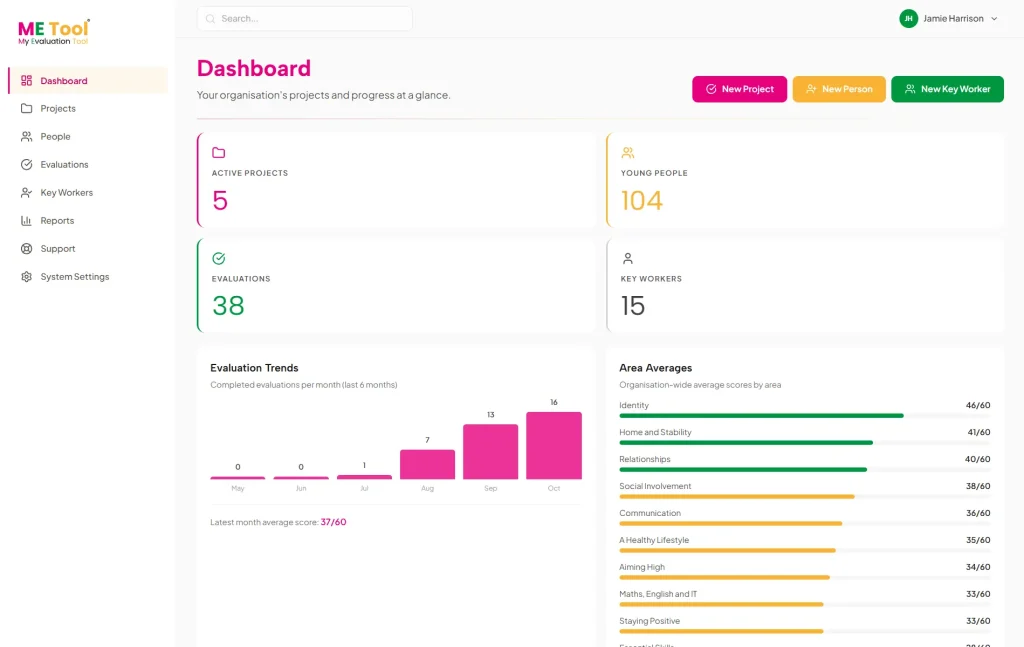
PARTICIPANT
Their own view
Progress in real time, actions to tick off, badges to earn. Message the key worker and do a daily wellbeing check. A unique ME Tool ID follows them across services, visible to them alone, so they do not retell their story.
KEY WORKER
Score in the room
Sign people up by button, QR code or upload, assign them to a named key worker, and assess on the spot or when circumstances change. Reminders, to-do lists tied to agreed actions, contact notes, and safeguarding notes visible only to linked colleagues.
ORGANISATION
Choose the areas
Track as many or as few of the ten areas as each project needs, and rename them to suit the group. Real time participant and cohort data. Caseload sizes, assessments done and last assessment date for every key worker. Individual, cohort and project reports.
BUILT TO SUPPORT THE RELATIONSHIP
The app supports the conversation and the work that follows, it does not replace either. Simple to use on any web-enabled device. Personal data is encrypted, every action is logged, and each organisation only ever sees its own participants. The paper version will remain available.
What it costs
One annual licence for your whole organisation, in three bands by the number of practitioners using it. The first-year price includes training and set-up, then a lower renewal price. No per practitioner fee and no per head training charge, so a team of six pays the same as a team of two.
small
Paper Licence
£1,300
First Year
£650
Renewal
Web App*
£1,800
First Year
£1,000
Renewal
Up to 6 Practitioners
medium
Paper Licence
£2,400
First Year
£1,200
Renewal
Web App*
£3,200
First Year
£1,800
Renewal
7-15 Practitioners
large
Paper Licence
£3,500
First Year
£1,800
Renewal
Web App*
£4,800
First Year
£2,700
Renewal
16-40 Practitioners
Multi-site
Paper Licence
On Quote
Web App*
On Quote
Over 40 Practitioners
Guide prices at September 2026 and subject to change. The price in your licence agreement is the one that applies. VAT treatment to be confirmed. Employers and multi-site organisations: ask us for a quote. *Web app prices apply from full release, planned for April 2027.
Discounts
Charities and community groups based in Cumbria get 15% off. Organisations with an annual income under £50,000, which includes most small youth clubs, sports clubs and community groups, get a special discounted rate: ask us!
Ready to make a difference?
The best way to understand the ME Tool is to talk it through.
Tell us a little about your organisation and what you’re looking for, and we’ll arrange a conversation, or a demo of the digital ME Tool, at a time that suits you.